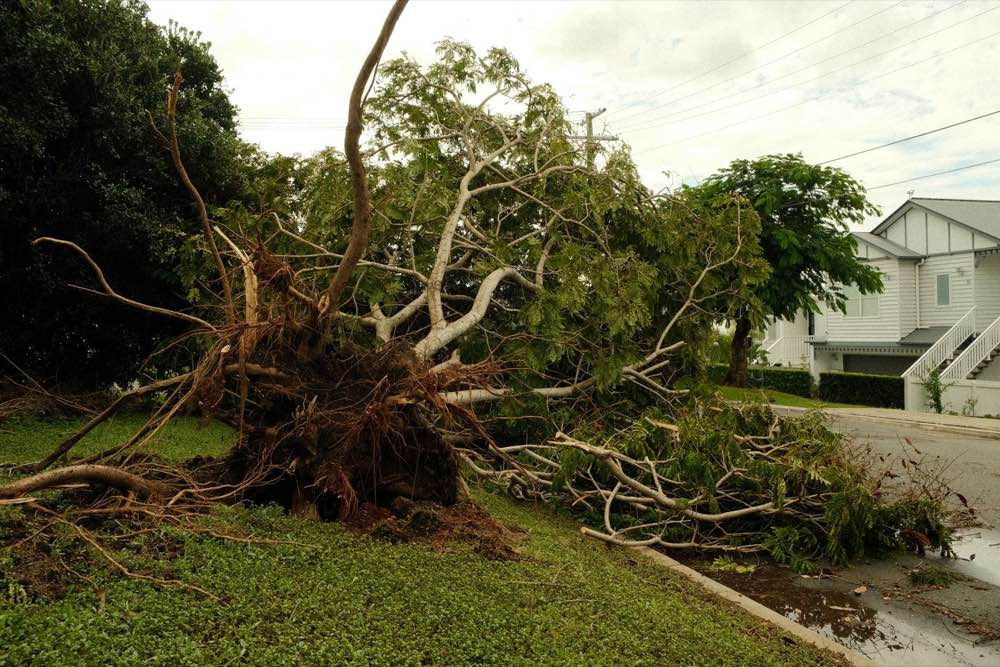
When a tree is already down
A fallen tree might seem like the easy case since the hard part is over. Often it isn't. Trees that came down in a storm are frequently twisted, pinned under their own weight, hung up in other trees, or lying across something. Wood in that position is under tension and compression, and cutting it in the wrong place can make it spring, roll, or drop.
What fallen tree removal includes
- Cutting the trunk and branches into manageable pieces.
- Lifting weight off fences, cars, sheds, or roofs.
- Dealing with the root plate. When a tree uproots, the root ball often stands up with a wall of soil attached and can tip back toward the hole once the trunk is cut.
- Chipping brush and hauling or stacking logs.
- Grinding the stump or filling the root hole, if you want.
Where it fell matters
- In the open yard. Usually the most straightforward. The crew cuts it up, chips brush, and hauls or stacks wood.
- Across a driveway or road. Often top priority so you can get in and out. A crew may clear a lane first and come back to finish.
- On a fence. Lift the weight off before cutting to avoid more damage. Fence repair is a separate job.
- On a roof or car. Treat it as an emergency. Rigging or a crane is often needed to lift the trunk off without dropping more weight onto the structure.
- Hung up in another tree. Very dangerous. Don't go under it. A "hung" tree can come loose without warning.
What to do before the crew arrives
- Keep everyone away from the tree, including the root plate and any branches resting on other trees.
- Look for wires before going near it. If any line is down or touched, call the utility.
- Take photos for insurance.
- Call (478) 309-7511 and describe where the tree is, roughly how big it is, and what it's touching.
What affects the price
Trunk size and length, whether it's resting on anything, how much wood is under tension, how far the crew has to carry or drag wood to the truck, whether the root plate needs to be cut and set back, and how much you want hauled away. Removing a fallen tree is often cheaper than removing a standing tree the same size, but storm demand and difficult positions can change that. See the cost guide.
Safety notes
Most chainsaw injuries during storm cleanups happen on trees that are already down. If you cut small branches yourself, stay off anything bent or pinned, wear chaps, eye and ear protection, and gloves, and never cut above shoulder height. Leave the trunk, the root plate, and anything resting on a structure to a professional.
Frequently asked questions
Can I just cut it up myself?
Small trees in the open, maybe, if you're experienced with a chainsaw. Big trunks, uprooted trees, and anything resting on a structure are best left to a pro.
Does insurance pay to remove a tree that fell in the yard?
It depends on the policy. Many policies cover removal when the tree damaged a covered structure, and may not cover trees that fell without hitting anything. Check with your insurer.
What happens to the hole where the roots came up?
The crew can cut the root plate and set it back in the hole, or grind it and fill the hole with soil. Ask what's included.